
When Glimpses Are Enough

When I started What Effort Reveals, I imagined it would include a lot more writing about triathlon, training, endurance sport and the strange things we voluntarily do to ourselves in the name of becoming better.
Instead, somewhere along the way, it became a place where I wrote more about identity, midlife, fear, relationships, leadership, disappointment and the quieter work of becoming ourselves.
I am grateful it did.
But every now and then, the athletic journey deserves a place here too. Not because the sport is the point, but because it continues to reveal things I could not have learned any other way. Perhaps that’s especially true in midlife, when so many of us find ourselves rediscovering old parts of ourselves, or stumbling unexpectedly into entirely new ones.
Less than twenty-four hours after knee surgery, I found myself lying on the couch, starting this essay, and wondering whether I will ever race competitively again.
At first glance, this may appear to be an essay about triathlon. And in one sense, it is. But the sport is not really the point. It is simply where this story happened.
The deeper story is about what can happen when, late in life, we encounter a part of ourselves we had assumed we had missed the chance to become.
Six years ago, I could not swim.
Not because I had been injured or had lost the ability. Not because I was merely bad at it. I had literally never learned.
My first attempt consisted of kneeling in the kiddie pool, hands on the edge, and lowering my face in the water to blow bubbles through my nose. I was fifty-seven years old, surrounded by people who seemed to have known how to swim forever, trying not to feel ridiculous.
I did not own a proper bike. I had never run any real distance before. Not even five kilometres.
But I taught myself to swim. I then bought a triathlon bike. I began following structured training plans (thank you 80/20 Endurance). I learned to ride farther than I had imagined, to run when my body wanted to stop, and eventually to put all three sports together.
Within one year of blowing bubbles in the kiddie pool, I completed three Half Ironman races in four months.
By the end of that first season, I was ranked first in my age group in Canada in the World Ironman standings and had earned Ironman All-World Athlete recognition.
I honestly thought I was just getting started. And what an extraordinary start it had been. Then things began to unravel. In 2022, I set myself the goal of completing a Half Ironman in under five hours. Instead, the following series of events occurred.
1. I suffered a stroke and two transient ischemic attacks.
The stroke occurred two weeks before my A race. Hoping to salvage something from the season, I later entered a shorter Olympic-distance race.
2. I began experiencing tachycardia
Even the easiest of slow jogs off the bike sent my heart rate over 200 beats per minute. So I cancelled the race.
Then I cancelled everything else. I stopped training. I rested.
By 2023, I had already been dealing for nearly three years with chronic insertional Achilles heel tendinopathy. I began training for the marathon portion of Challenge Roth, one of the world’s iconic long-distance triathlons.
3. I developed plantar fasciitis.
I ran my first marathon anyway. Three hours and forty-six minutes. At Challenge Roth. With plantar fasciitis. That was fun.
4. I tore my plantar fascia during the marathon.
That was less fun. I stopped running for eight months.
In 2024, I started, what seemed to be, all over again.
5. I got COVID for the third time.
My partner Julie injured her hip, and we, again, cancelled our races. The year became less about competition than simply staying in motion.
Finally, in 2025, I started running. Again. The torn fascia remained something to manage. So did the heel. So I cancelled the longer races but kept two shorter ones.
I podiumed at the Kingston Triathlon. Then, placed second at the Olympic distance at Challenge Esprit Montréal.
There were still enough glimpses. Enough to know someone was still there. Enough to reset the sub-5 hour goal, yet again, this time in 2026.
January arrived.
6. I tore the meniscus in my right knee.
I could not run. For eight months, I could barely walk any distance without pain. By late July (at time of writing), I had not walked my dog down the street since November 2025. I had not run since Montréal. Almost a full year.
Again, every race disappeared from the year’s race calendar. Sardinia. Montréal. Georgia.
On July 23, I underwent knee surgery consisting of a meniscectomy and debridement. And now rehabilitation begins.
That is the chronology.
The races entered. The podiums. The injuries. The cancellations. The surgeries. The restarts.
Lying there after surgery, looking back across those six major setbacks in five years, I realised the chronology was not really the story.
It was simply where the story happened.
The facts explained what had occurred. They could not explain why any of it had mattered so much.
Sure, disappointment surfaced as an emotion, but why did finding this so late in life feel so strangely like coming home?
Years ago, while writing One Foot in Front of the Other, I borrowed Jungian psychologist James Hollis’s idea of the “middle passage.”
I understood midlife, for me, as not merely a shedding of masks I had learned to wear, but also as a return to the athlete I had imagined becoming as a boy.
At the time, I thought I understood what I meant, but I think I had reached too clean a conclusion. But I am only beginning to understand it now.
For me, that return arrived wearing the clothes of triathlon.
I suspect this is one of the gifts of midlife, and what makes it truly a passage. Not because rediscovery belongs only to the middle of life. It doesn’t. But by then, we have accumulated enough years, careers, obligations and versions of ourselves that we can finally recognise what may have been buried beneath them.
We spend decades learning how to become responsible adults. Then, almost by accident, something asks us to remember who we were before all of that.
The arithmetic of my own life is almost too neat.
At seven, I imagined the athlete I might become.
By twenty-seven, I had learned how to be an adult.
Over the next thirty years, I became competent in roles that were real, important and sometimes deeply meaningful, but never the whole of me.
Then, at fifty-seven, I remembered.
For me, that forgotten self was an athlete. Not an accomplished athlete. Not necessarily a great one. Simply the athlete I had once imagined becoming.
Life, as it often does, had other plans. Challenging family dynamics and a difficult childhood. The early deaths of my parents. University and then two careers. Children. Mortgages. Responsibilities.
Some of those things happened to me. Others were choices I made and lives I was privileged to help build. Raising my children, especially, was among the greatest gifts of my life.
I do not see those years as stolen. They were simply life.
And yet, somehow, beneath all of it, that young athlete never quite disappeared.
He just waited patiently.
When I discovered triathlon at fifty-seven and quickly learned what I might be capable of, I assumed the dominant emotion would be regret.
And, if I am completely honest, I did feel some. Why hadn’t I found this sooner? If I could accomplish that much in one year at this age, what might I have done with twenty? How fast might I have been?
Those questions visited from time to time. But they never stayed very long.
Because another emotion arrived that I had not expected: Gratitude. Not because I had become the athlete I had dreamed of becoming.
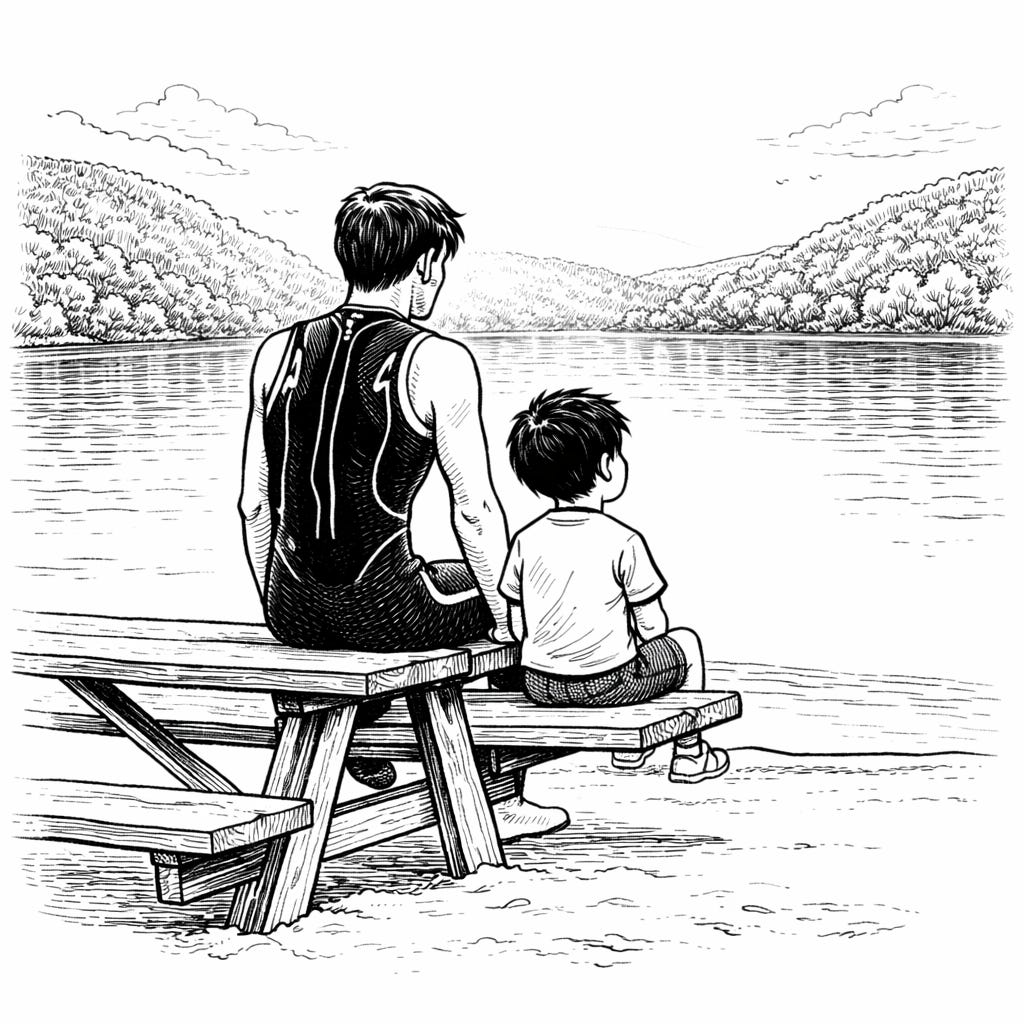
Because I finally got to meet him.
And what surprises me now is that those glimpses turned out to be enough.
Enough to know the dream had not been imaginary. Enough to know there really had been an athlete hiding somewhere beneath the decades. Enough to discover that rediscovery does not have to be accompanied by regret.
Sometimes it arrives simply as recognition.
For someone else, it may have nothing to do with sport.
It may arrive through music after decades away from the piano. Through painting after retirement. Through a garden that somehow becomes more than vegetables. Through learning another language later in life and discovering that an entirely different future remains possible. Through finally writing the novel that has been whispering in the background for thirty years.
The doorway matters less than the feeling. That startling recognition of something completely new and deeply familiar, as though you have just been introduced to someone you have known all your life.
As these thoughts have been settling, I keep returning to one quiet exchange near the end of The Natural, my favourite film of all time.
Perhaps I finally understand why.
Roy Hobbs returns to baseball for one remarkable season after losing most of his adult playing years. He says he could have been “the best there ever was.” People would have pointed to him in the street and said, “There goes Roy Hobbs.”
I no longer hear that as simple ego. I hear the grief of someone measuring the life he actually lived against the greatness he once imagined.
Then Iris asks the question that quietly dismantles the fantasy.
“And then what?”
It is such a simple question.
Not because records or greatness are meaningless. They aren’t. But because they cannot, by themselves, answer the deeper question Roy is asking. Being recognised is not the same as being fulfilled. Being remembered is not the same as becoming whole.
She quietly reminds him that the records were never the whole story. In the brief time he had, he still gave people something to believe in. His life did not become meaningless simply because it failed to match the myth he had carried for so long.
Most of us will never be remembered for home runs or records. Or winning Olympic gold.
But perhaps that was never the proper measure. Perhaps the measure is found in the people we encouraged. The lives we touched. The person we became while pursuing something we loved.
Lately, I have been wondering whether that conversation asks another question as well. What if the point was never becoming the best there ever was? What if the point was simply becoming ourselves?
Roy never recovered the years. But he recovered something of himself.
In my own way, so did I. The melancholy may be real. But the homecoming is stronger.
I am beginning to suspect that many of us carry around some version of that forgotten self. Someone we quietly assumed we had missed the chance to become.
By a certain age, “It’s too late for me” can begin to sound less like an excuse and more like an established fact. Sometimes the door is not locked. We have merely spent years telling ourselves it is.
Perhaps what stops us is the fear that nothing extraordinary waits behind it. That we will pick up the instrument, lift the paintbrush, lace the shoes or begin writing and discover that we are not Mozart, Picasso or Lionel Messi.
But becoming extraordinary was never the invitation. Becoming more fully ourselves was. And effort may be the only way to reveal who that fuller self might be. We cannot learn what waits beyond the door by standing safely outside it. We have to open it and step through.
One foot in front of the other.
I sometimes wonder whether some of the bitterness we associate with ageing begins there. Not in the passing years alone, and not because every door remains equally open. Bodies, injuries and illness, money, loss and responsibility all narrow the field. Some doors really do close.
But sometimes the bitterness grows from deciding in advance that the vulnerability of beginning again is no longer worth the risk.
There need not be a Hollywood ending like the one in The Natural, with a walk-off home run and the stadium erupting in fireworks.
Maybe catching a glimpse of what might have been is not an invitation to regret at all. Maybe the purpose of opening the door is not to prove that we could have become extraordinary. Maybe it is simply to rediscover who we are and what remains alive in us.
That is what effort revealed to me.
I did not become the athlete I might have been.
But I met him.
The glimpses have been enough.
Marc, this is so brilliantly and thoughtfully done. Your personal journey - accomplishments, setbacks and lessons learned - were fascinating to read about. And I think the perspective you bring to this as a man in midlife reflecting makes it possible for all of us, even those of us who have never dabbled in endurance sports, to relate. Another fantastic piece, my friend. Thank you!